Walking towards the National Museum of the History of the Great Patriotic War at the weekend of the 12th/13th July 2014, whilst listening to patriotic WW2 songs playing from speakers scattered around the area, it became obvious that it was a poignant place chosen by the Ukrainian presidential administration to display the war technology that was captured by Ukrainian troops from Russian separatist forces in the cities of Sloviansk and Kramatorsk a week earlier.
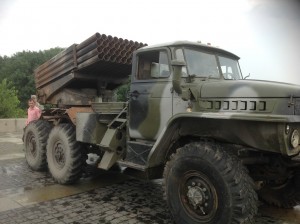
The Commander of Ground Forces of the Armed Forces of Ukraine, Lieutenant General Anatoliy Pushnyakov, introduced BM-21 Grad systems; MANPADS; different types of rocket-propelled grenades and other anti-tank weapons; the self-propelled mortar Nona; various types of anti-personnel mines, including the MON-50; as well as previously decommissioned Soviet military hardware that used to be in Russian depots. We were also shown Russian passports and military IDs, as well as other Russian documents. Whilst a lot of the weapons and hardware were made prior to 1991, those dated post-1991 had Russian markings and are produced and used by the Russian armed forces.
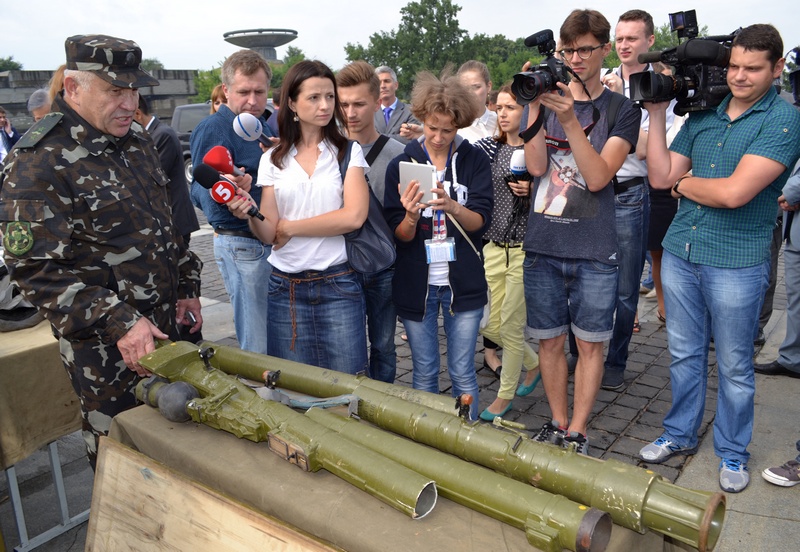
On display was also a large cache of weapons, ammunition and mines produced by Russia’s Chelyabinsk factory that were found in the Church of the Moscow Patriarchate in Sloviansk. Under the watchful eyes of Ukrainian military commanders, foreign military attaches and a rather small general public, Iryna Herashenko, the presidential envoy for the settlement of the conflict in Donetsk and Lugansk, said that “this evidence was taken to Kiev so that Ukraine and the rest of the world can see how Russia is ‘not involved’ in the conflict.”
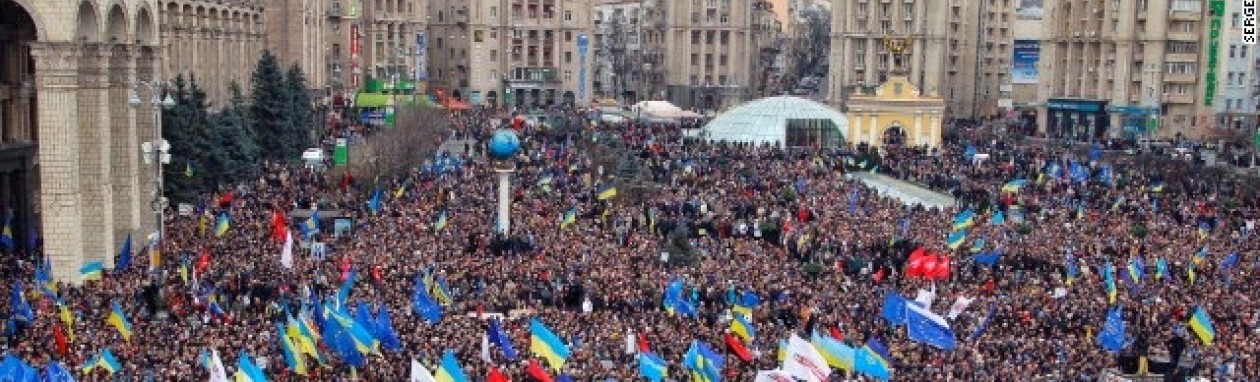
For a foreign analyst who was on the Maidan at the end of February 2014, and who experienced the arrival of the “men in green” in Ukraine, it is not without bitter irony that the Putin administration is still denying any involvement in the crisis in Ukraine. The display of Russian weapons in Kiev is only the tip of the iceberg, as there is mounting evidence that Russia has been supplying different separatist groups with tanks, armoured vehicles, military trucks, rocket launchers, artillery and air defence systems throughout June and July 2014.
On 11th July 2014, BTR armoured personnel carriers (APCs), antitank guns and trucks were seen crossing the border near Izvaryne and heading towards Donetsk. Footage from the same day also shows a convoy of three airborne combat BMD-2 APCs, two light BMP tanks, one 2S9 self-propelled gun and a BTR-60 APC near Donetsk. Social media videos posted 14th July show a convoy from Luhansk to Donetsk consisting of at least five T-64 tanks; four BMP-2 APCs; BM-21 GRAD mobile rocket launchers; three towed antitank guns; two ZU 23-2 anti-aircraft guns and a 2B16 mortar. The sense of danger from military hardware in the hand of Russian para-military units was heightened this week when a Ukrainian Antonov-26 and two Sukhoi-25 fighter planes were shot down over Ukrainian territory.
Few Ukrainians, if any, could have imagined T-64 tanks rolling past their homes in the year 2014 and being used to threaten the territorial integrity of their country. Glancing back at the captured military hardware on my way out of the museum park, I could not help but think about the two permanently displayed Ukrainian T-64 and T-72 tanks which are painted in a flower-power style and used by children as climbing frames – and who were the whole time positioned next to the captured military hardware that was on display for only the weekend. One can only hope that one day the captured Russian armoured vehicles and military hardware will have the same fate, and that the date of their display, exactly 70 years on the day that General Konev established a new western border for the USSR, will be of no historical significance.
 russiaandeurasia